The most common feedback I heard from customers in my decade long tenure in enterprise productivity is that they often need to reconstruct project context before contributing to a task. To understand what’s going on in a project, workers often need to reconstruct context manually by piecing together information from issues, comments, documents, and updates.
The problem is no longer missing information — it’s fragmented context.
This process is time-consuming and cognitively demanding, especially when joining a new project or returning after time away. I wanted to explore how to help users reconstruct project context more efficiently by making relationships between work, people, and events more visible.
To understand how workers navigate productivity tools and gather project context, I conducted competitive analysis and generative interviews with knowledge workers across engineering, operations, and management roles. Participants regularly used tools such as: Google Calendar, Slack, Jira, Asana, Notion, and Microsoft Office.
Through research, I found that workers reconstruct context through three key anchors:
This suggests that improving context is not about surfacing more information, but about structuring existing information so users can reconstruct a clear narrative of what has happened.
Based on this, I explored how work information could be organized into a clear hierarchy and presented through a timeline that surfaces these signals together.
If work information were organized across clear levels of abstraction and presented through a timeline that surfaces artifacts, ownership, and events together, users could more quickly understand project context without navigating across multiple tools. This hypothesis led to two key design directions:

To support context reconstruction, the system focuses on making three key signals visible and connected:
RECONSTRUCTING CONTEXT THROUGH STRUCTURE AND TIME
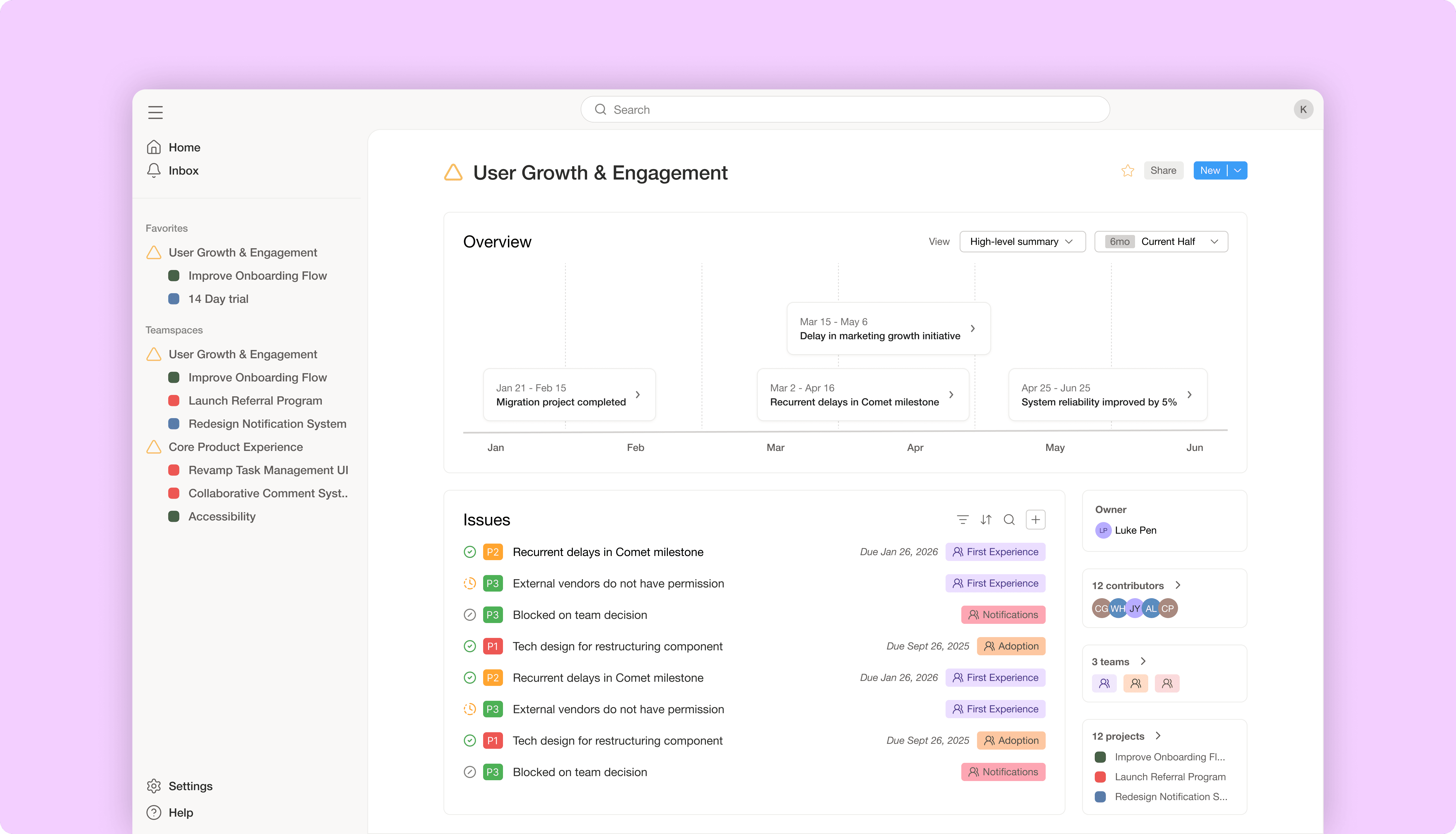
To help users reconstruct project context, I designed a system that organizes work across a clear hierarchy and presents activity through a timeline. Instead of requiring users to search across fragmented tools, the system brings together the key signals needed to understand context: what happened, who was involved, and how work evolved over time.

INTEGRATING AI AS A SUPPORTING LAYER
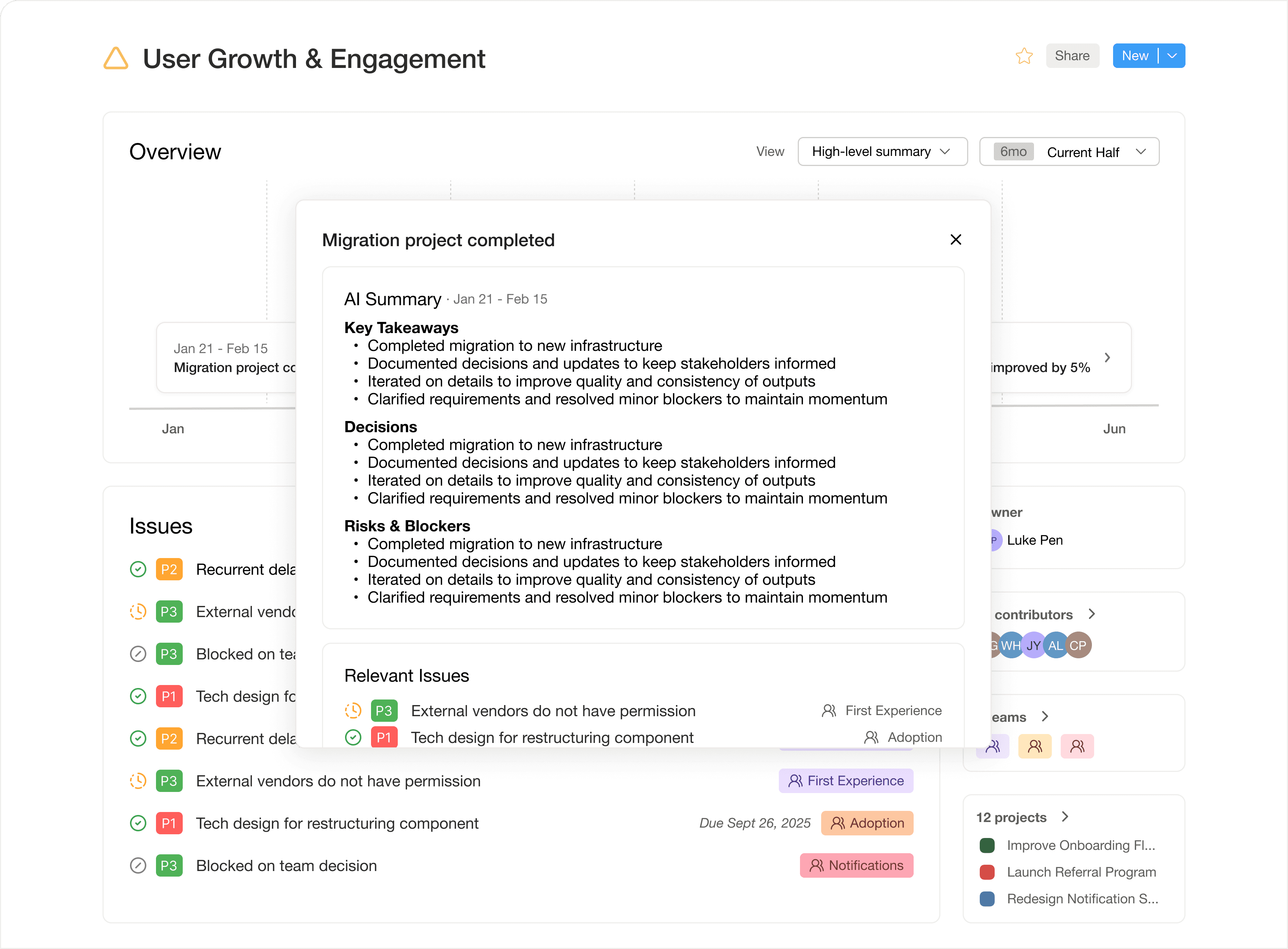
AI-generated summaries are embedded within the timeline and linked to underlying artifacts. Rather than replacing exploration, summaries help users quickly orient themselves while still allowing them to verify context through the source of truth.
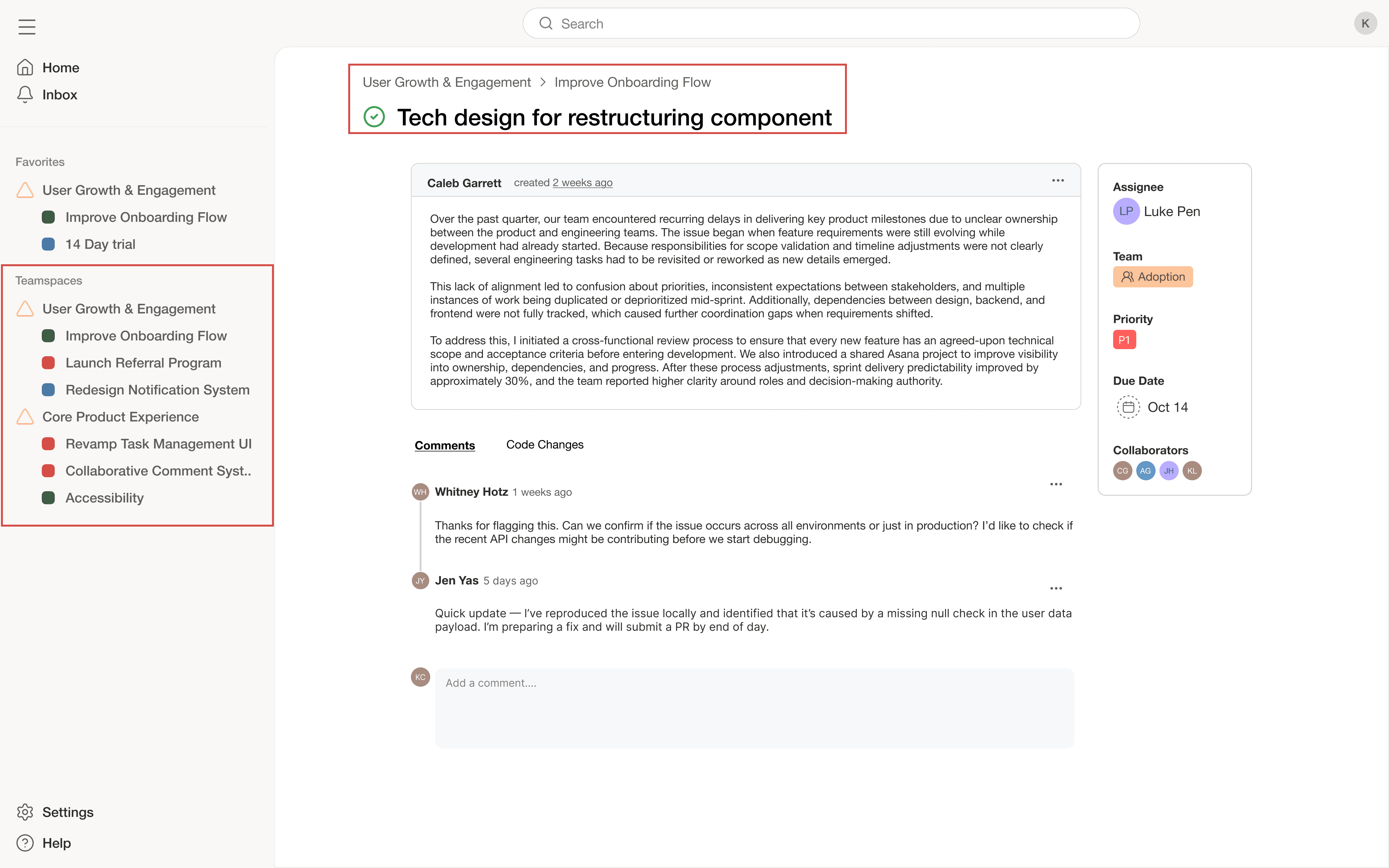
STRUCTURING ARTIFACTS THROUGH A HIERARCHY
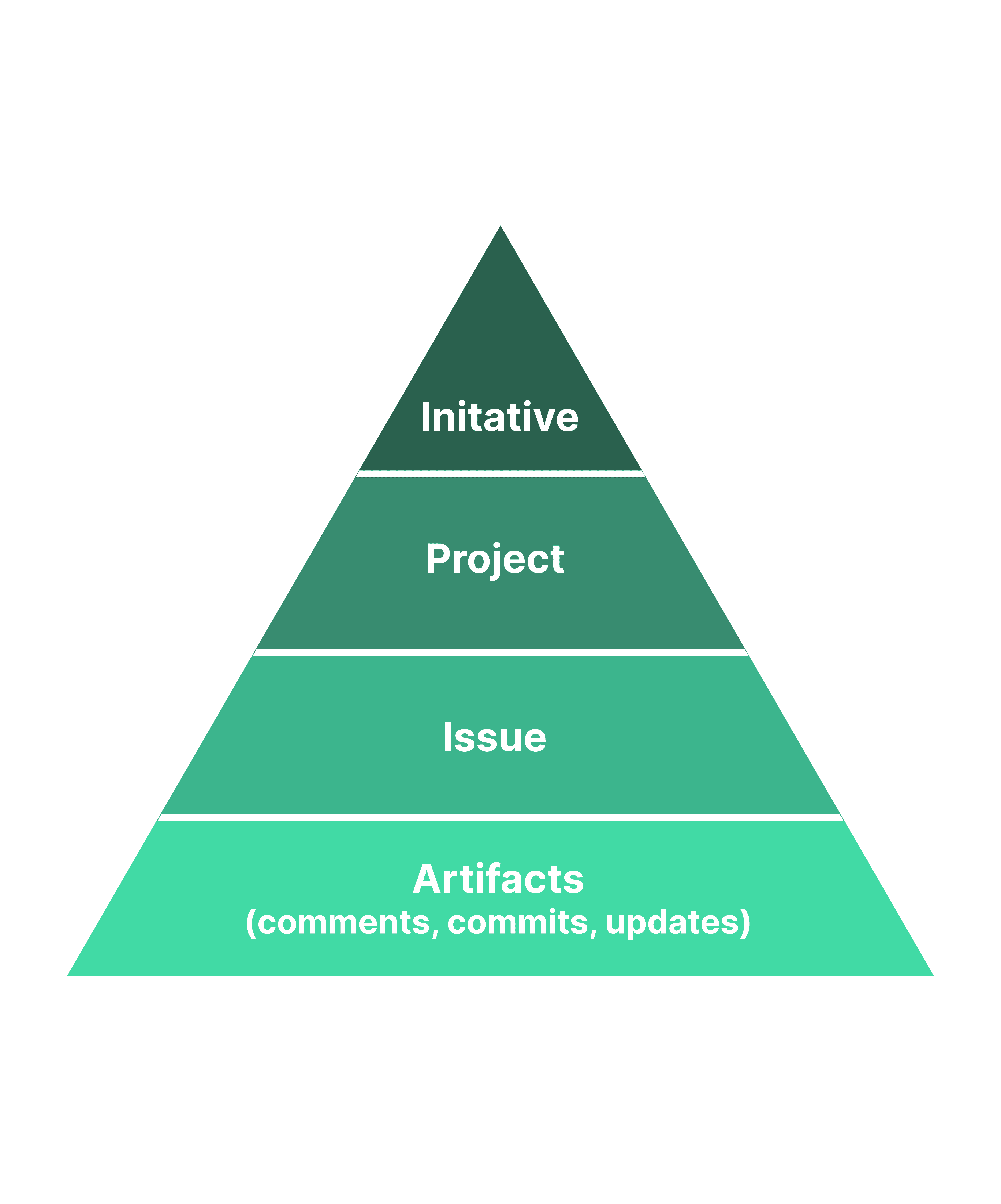
Work is organized across three levels: Initiative → Project → Issue.
This structure allows users to understand context at different levels of detail, from high-level goals to specific execution. By grouping related work, users can quickly navigate to the relevant scope without manually piecing together scattered artifacts.
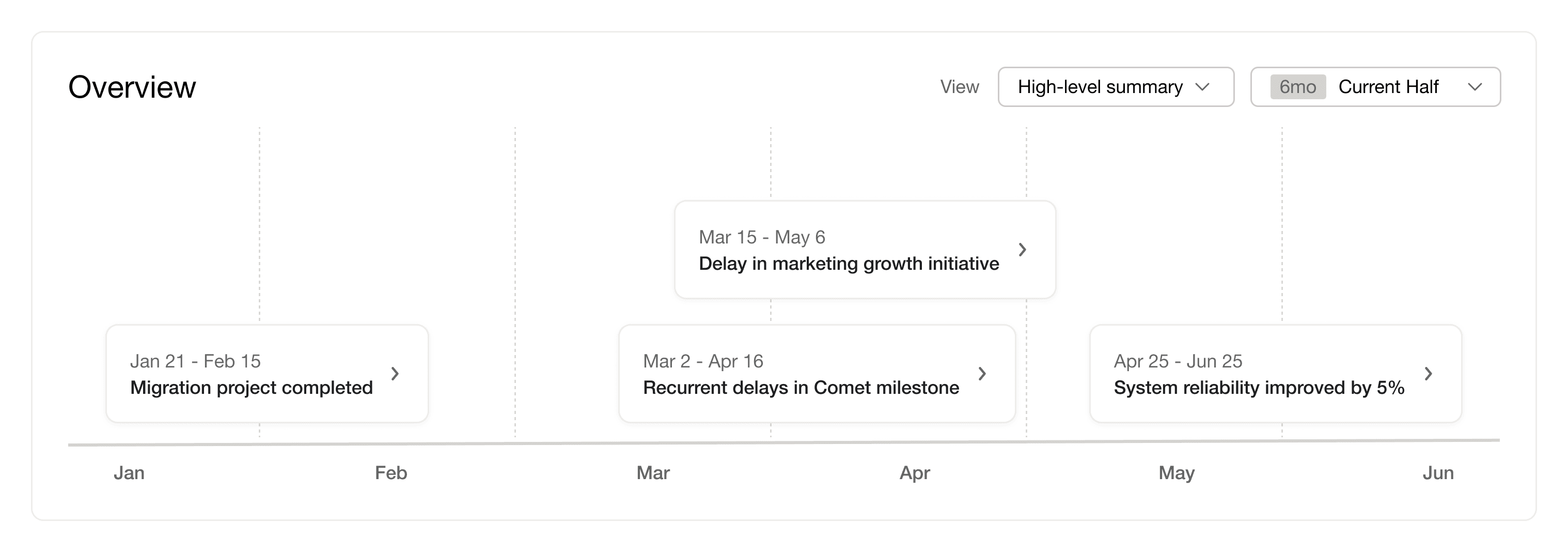
REPRESENTING PROJECT HISTORY THROUGH A TIMELINE
A chronological timeline surfaces key updates, decisions, and activity across the system. This aligns with how users naturally reconstruct context by scanning what happened over time and drilling into relevant events. Instead of reading long summaries, users can quickly orient themselves and explore deeper as needed.
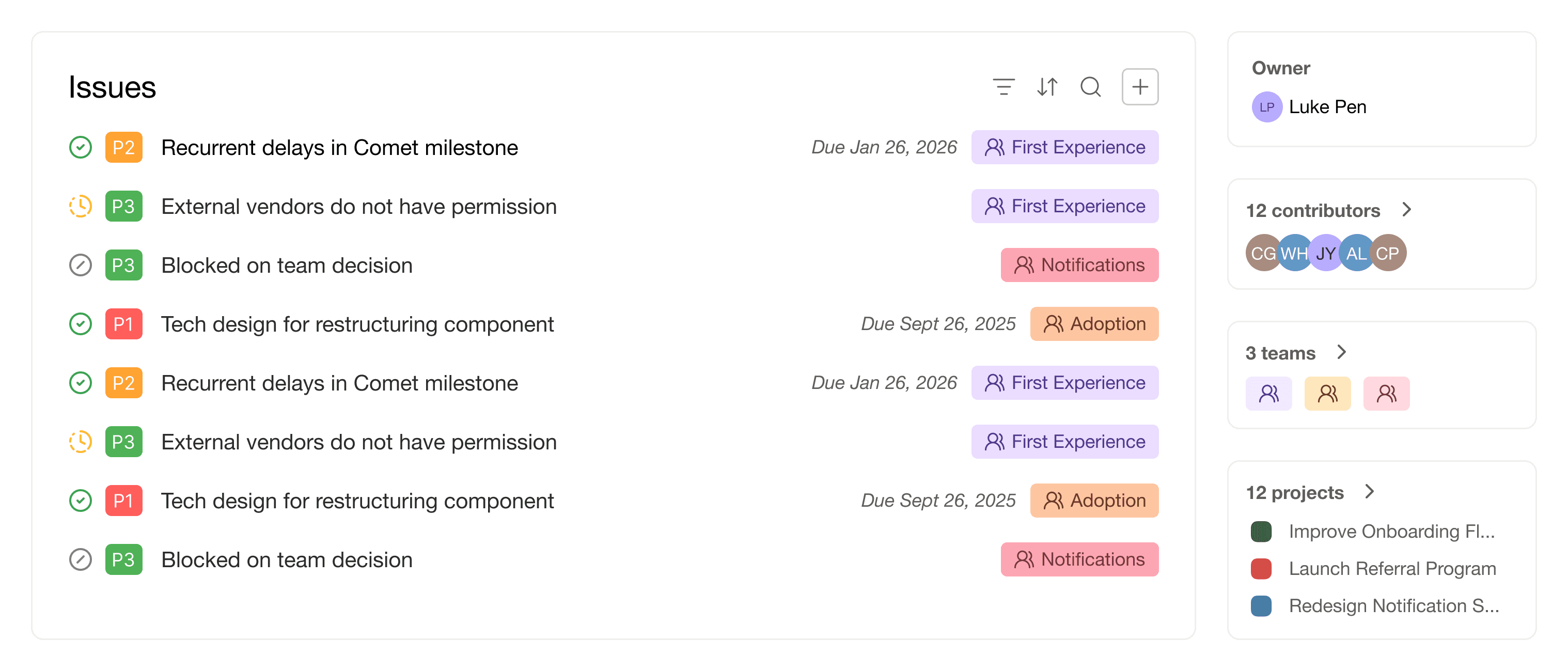
SURFACING OWNERSHIP ACROSS THE SYSTEM
Ownership is made visible at the initiative, project, and issue levels. This allows users to quickly identify responsible stakeholders and understand who to follow up with, reducing the need for manual coordination.
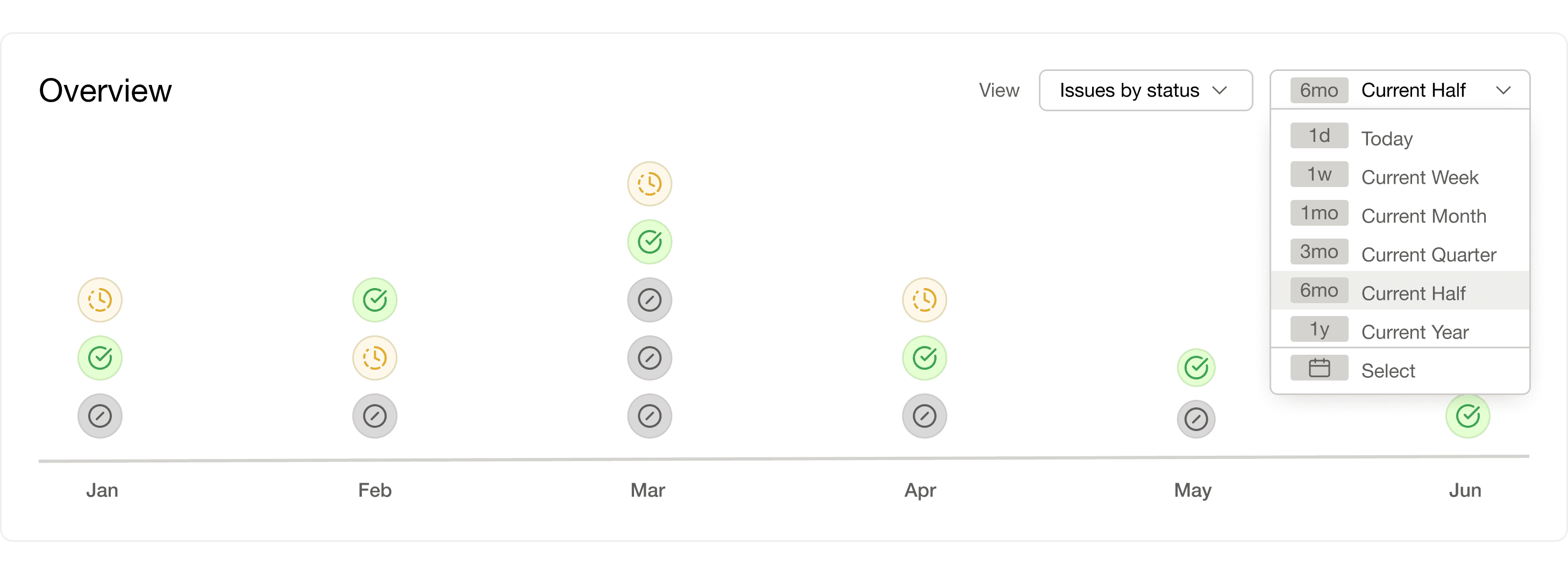
SUPPORTING FLEXIBLE LEVELS OF DETAIL
Users can move between high-level overviews and detailed artifacts, allowing them to quickly orient themselves and then investigate specific parts of the work. This supports both quick context discovery and deeper exploration without losing continuity.
LEARNING HOW USERS RECONSTRUCT CONTEXT
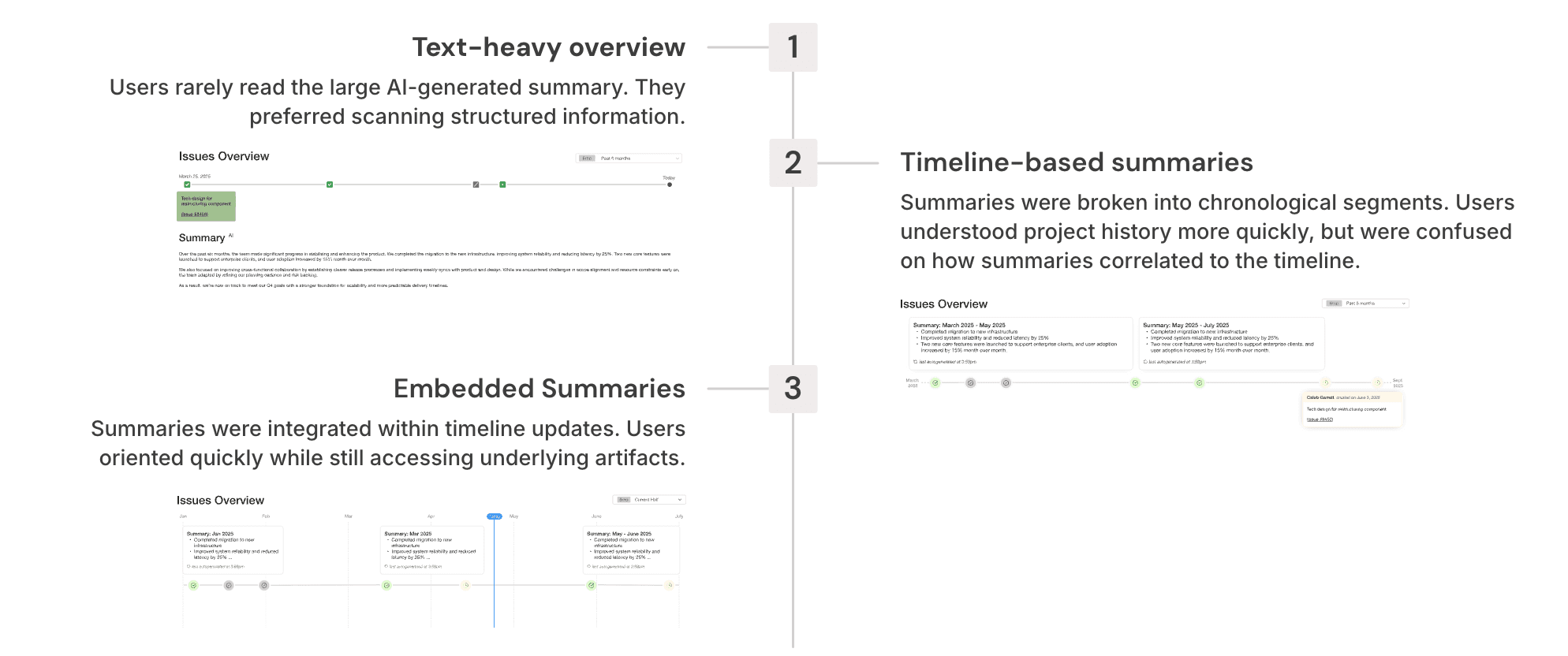
The presentation of the AI-generated summary and how it's incorporated into the timeline was the focus of all the rounds of iteration. Each round of testing revealed gaps between how I initially presented information and how users actually navigated and made sense of it. These learnings led to shifts in how context was structured, moving from static summaries toward a more integrated, timeline-based approach.
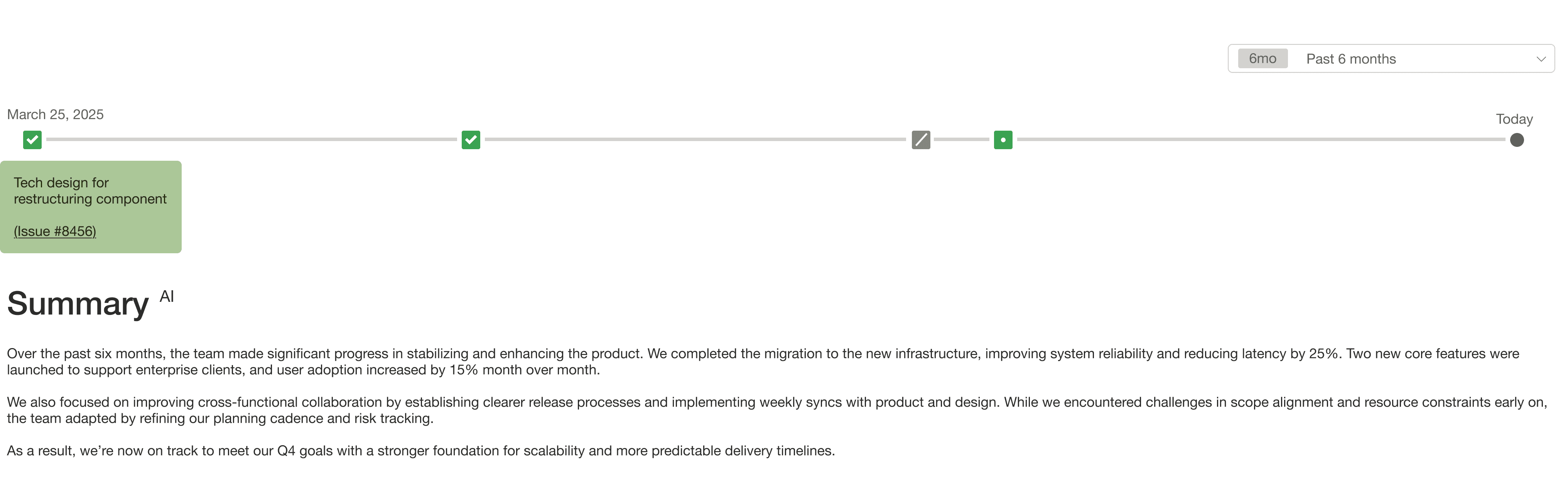
Iteration 1: Timeline Over Text
Early AI summaries were long text blocks users didn't read. Embedding summaries into a timeline dramatically improved scannability.
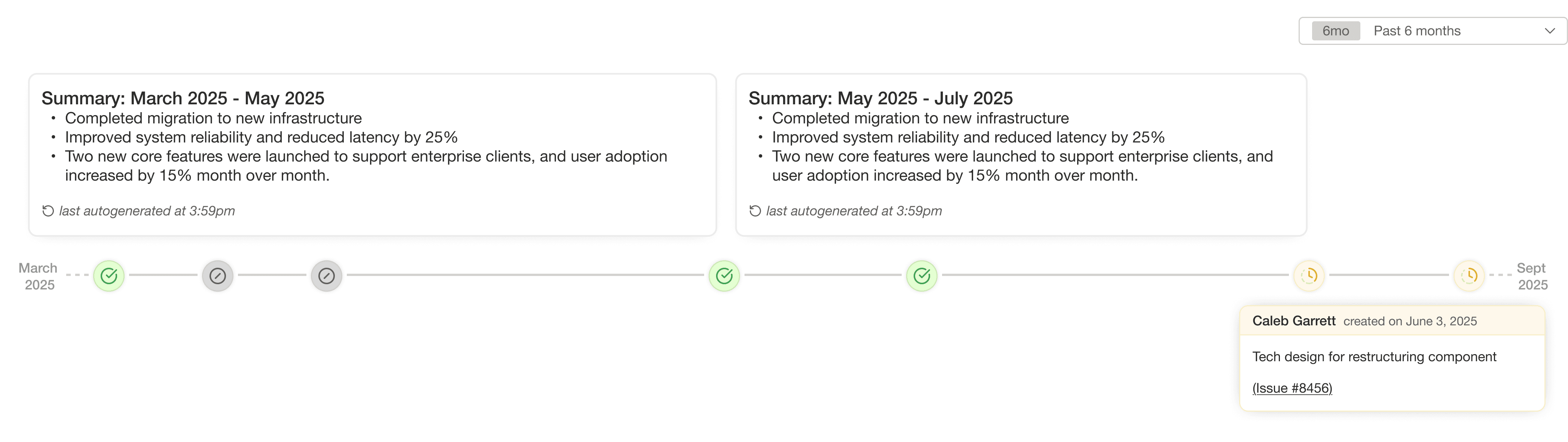
Iteration 2: Embedding Summaries within the Timeline
Summaries became broken into segments and integrated into the timeline. Users find this more scannable, but still struggled to correlate how summaries related to the timeline.
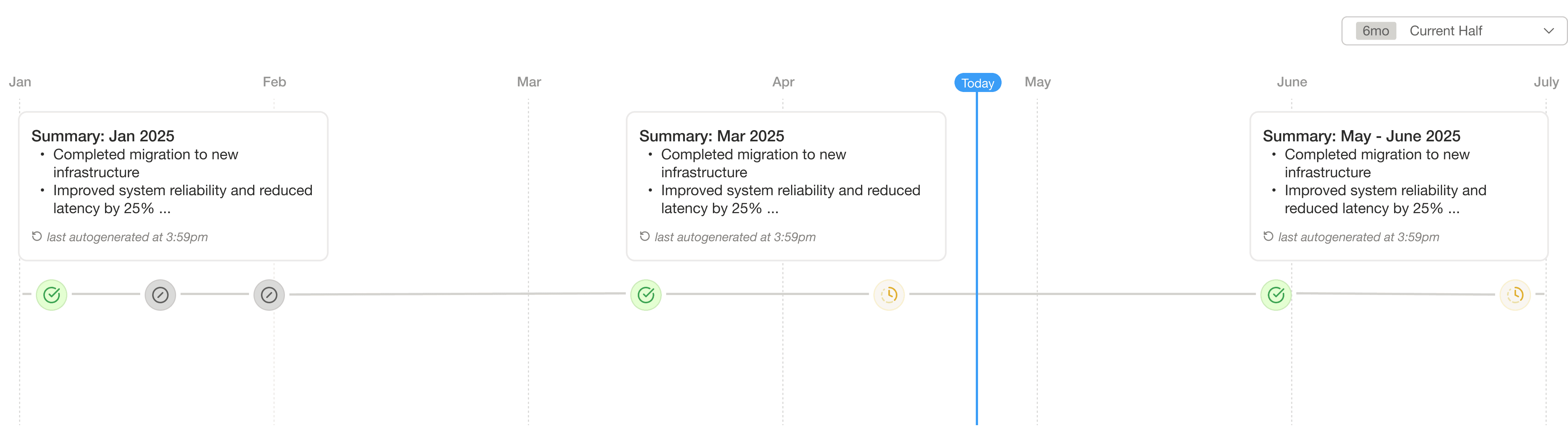
Iteration 3. Added Visual Time Markers
I introduced visual time markers, such as a “today” indicator and monthly dividers, to better anchor events within the timeline. This helped users understand when events occurred relative to each other and improved their ability to reason about recency and progression.
This project gave me further insights into the importance of AI transparency in driving adoption. Early versions relied heavily on AI-generated summaries, but testing revealed users rarely trusted summaries alone. They preferred building understanding from underlying artifacts such as issues and updates.
AI insights are only trustworthy when users can understand where they come from.
This suggests that transparency is not just about explaining how AI works, but about preserving access to source information. AI is most effective when it helps users orient quickly while still allowing them to trace and validate the underlying data.